

Microneedling and RF microneedling: benefits, recovery, risks and real prices
Both treatments have been studied for acne scars and other skin concerns. Radiofrequency adds heat, settings and important safety questions—not a guarantee of better results.
In 30 seconds
Microneedling uses tiny punctures to stimulate skin healing; radiofrequency (RF) microneedling adds energy that heats tissue. Small human studies suggest improvement in acne scars, but they do not establish long-term results or show that RF is best for everyone. Recovery and costs vary. Serious RF injuries, including burns and nerve damage, have been reported to the FDA. Get a diagnosis and a written quote before committing.
Reader questions answered
What is the difference between microneedling and RF microneedling?
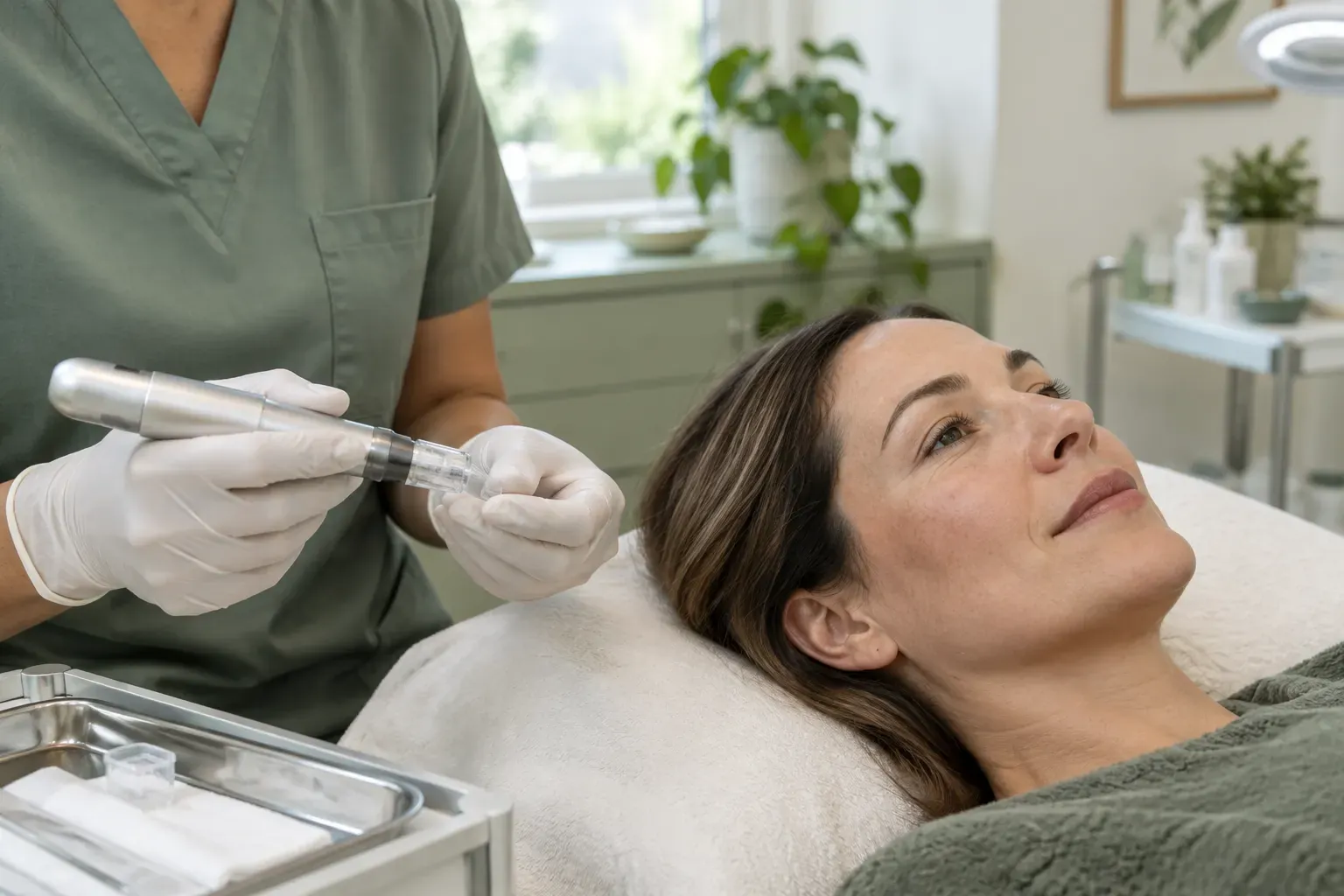
Professional microneedling creates controlled, tiny punctures in the skin to prompt a wound-healing response. RF microneedling also passes radiofrequency energy through needle electrodes, adding heat at selected depths. Both aim to improve skin appearance gradually rather than produce an immediate surgical lift.
The distinction matters because RF adds energy and heat-related decisions to the procedure. The device, treatment depth and energy settings are relevant to both the intended effect and the potential for injury. RF is not automatically the better choice for every scar, skin tone or cosmetic goal.
At-home rollers are not an equivalent substitute for professional treatment: the American Academy of Dermatology (AAD) warns that home devices can cause infection, scarring and pigment changes. The FDA advises against home use of RF microneedling devices.
Which problems have been tested in human clinical studies?
Human studies have examined acne scars, wrinkles and photoaging, skin laxity, stretch marks, melasma, rosacea and other conditions. Being studied is not the same as being reliably effective: the evidence differs substantially by condition. A 2026 RF systematic review included 41 studies across indications, but their methods and outcomes varied, making a single dependable estimate of benefit difficult.
Acne scars have some of the more useful comparative evidence. In a randomized split-face trial, 33 people enrolled and 30 completed three sessions. One side of each face received RF microneedling; the other received fractional carbon dioxide laser. Mean ECCA scar-severity scores fell from 54.73 to 30.53 on RF-treated sides and from 53.67 to 31.03 on laser-treated sides. There was no statistically significant difference between treatments. RF had shorter reported recovery and fewer pigmentation events in that study.
That result does not prove the treatments are equivalent. The study was small and exploratory, and there was no sham-treated or untreated side. Detailed follow-up duration and funding were not established from the available abstract. The findings also compare RF with a particular laser approach—not with standard microneedling.
A second small split-face comparison, described in an RF acne-scar review, involved 21 patients. Clinician-assessed Goodman and Baron scar scores changed from 18.14 to 12.05 with RF and from 19.33 to 13.19 with fractional Er:YAG laser. Folliculitis was reported on the RF side; pigmentation and eczema were reported on the laser side. This is a secondary account, and long-term outcomes were not verified.
For a look-younger goal, studies of wrinkles and laxity are generally small and use varied measurements. A review of facial rejuvenation studies also identified limitations in blinding in randomized trials. Gradual improvement in texture or fine lines is a more realistic expectation than complete scar removal, a facelift or a predictable number of years off your appearance. Evidence for pigment disorders and several other uses is less settled.
How many treatment sessions are typically discussed and how long might improvement last?
A course rather than a single visit is commonly discussed. The AAD describes three to five microneedling sessions for acne scars, often two to four weeks apart. In the carbon dioxide laser comparison, participants had three RF sessions eight weeks apart. Those are examples of protocols, not a universal prescription.
Improvement can emerge over weeks and continue for months. But short follow-up limits what anyone can promise about durability: an RF acne-scar review covered 16 studies involving 481 patients, most followed for only one to six months after treatment. Some clinicians suggest annual maintenance, but that is not proof that everyone needs it or that results last a fixed period.
Ask what result will be assessed after the initial course, when it will be assessed and what would justify another session. A prepaid package may be less attractive if you would rather see how your skin responds first.
What are the important complications or reasons to seek medical advice?
Pain, redness or darker discoloration, swelling and pinpoint bleeding can occur. Infection, prolonged pigment changes and scarring are also possible. In its 2025 safety communication, the FDA described reports of serious RF injuries including burns, scarring, fat loss, disfigurement and nerve damage; some required medical intervention.
Those reports deserve attention, but they cannot tell you how often serious injury occurs or prove that a device caused every reported injury. Small studies tend to report more transient effects and are poorly suited to measuring uncommon harms. Neither source establishes your personal probability of a complication.
Before treatment, tell the clinician about active infection, a history of herpes, poor wound healing, a tendency to form keloids, medications and relevant medical conditions. These details can change whether treatment should proceed and what precautions are appropriate.
Seek prompt medical advice for increasing pain, spreading redness, pus, fever, blistering, numbness, weakness or a worsening wound. Severe symptoms warrant urgent care. Ask in advance whom to contact after hours and who will assess you if healing does not follow the expected course.
What does recovery involve and what can vary between patients?
Skin may feel sunburned and look red or darker, with swelling lasting from a few days to a week. Follow your clinician's instructions for gentle cleansing and moisturizer, protect the area from sun and ask when to restart products that may irritate it. The AAD advises waiting 24 hours before applying makeup.
There is no dependable single downtime figure. Depth, RF energy settings, the area treated, skin characteristics and individual healing can all matter. The small acne-scar trial reported shorter recovery with RF than with its fractional carbon dioxide laser protocol; that does not make every RF treatment low-risk or faster to recover from than every alternative.
Plan around the possibility that visible changes will last longer than you hoped. If symptoms worsen rather than settle, contact the treating clinician instead of assuming that the reaction is normal.
What do actual US providers quote and what is included in a session?
Published US clinic prices are budget examples, not national averages, comparative treatment results or endorsements. The pages were checked on 4 November 2026.
- Spectrum Skin Clinic, Irvine, California lists standard microneedling from US$400, PRP/PRFM combinations from $650 and Secret RF from $850. Three sessions at these starting prices would total at least $1,200 or $2,550 respectively, excluding extras.
- Oak City MedAesthetics, Raleigh, North Carolina lists $295 for traditional microneedling and $675 for RF microneedling per session.
Those listings may cover different areas, devices or services. Ask for a complete written quote covering the operator, named device, treatment area, numbing, aftercare and follow-up, plus package cancellation rules. The lower advertised price does not establish better safety.
How do dermatologist qualifications and device approvals change the safety discussion?
A board-certified dermatologist can assess the diagnosis, skin type and alternatives as well as help manage complications. The FDA recommends a licensed healthcare provider trained and experienced in RF microneedling. Ask who will actually perform your treatment, their license, the supervision arrangements and their experience with the named device and your skin tone. US scope-of-practice and supervision rules differ by state.
Check the exact device's FDA clearance and stated indications rather than accepting a general claim that a treatment is “FDA approved.” Clearance is device- and use-specific; it is not a guarantee of safety, proof of operator competence or endorsement of every advertised cosmetic result. For example, the MILAN System 510(k) summary specifies dermatologic electrocoagulation and hemostasis indications and restricts higher-energy use to skin types I–IV. That document is not blanket authorization for all RF devices or proof that every device improves wrinkles.
Likewise, research on the RF microneedling category should not be treated as proof that a particular retail device or branded protocol will produce the same result. Ask for evidence relevant to the exact device, indication and proposed settings.
When might alternatives or no treatment make more sense?
Doing nothing is a reasonable decision if the likely improvement is not worth the cost, healing time or risk to you. A consultation should start with what is causing the concern, not with a device already selected.
For photoaging, sun protection and clinician-guided topical retinoids may be lower-intensity options. Acne scars can require different approaches depending on their characteristics, including subcision, selected lasers or combinations; active acne also needs attention. The comparative scar trial illustrates that laser is one possible alternative, not that it is automatically preferable or risk-free.
An individualized dermatology assessment is especially useful for pigment disorders, active infection, a tendency to scar or expectations of surgical-level lifting. Ask what each alternative can realistically change, its own risks and recovery, and whether treating now is necessary at all.
What this means for you
Bring one specific goal to a consultation—such as improving particular acne scars or softening fine lines—and ask how it will be measured. Then compare a complete treatment plan with the option of waiting:
- Diagnosis and evidence: Has this exact concern been studied, and how closely do the patients and treatment resemble yours?
- Operator and device: Who treats you, what device and settings are proposed, and what are its cleared indications?
- Course and cost: How many sessions are recommended, what is included in the written quote, and can you reassess before buying more?
- Safety and recovery: What makes you a good or poor candidate, what should normal healing look like, and who handles complications?
The conclusion would become more certain with larger, well-controlled comparisons of standard and RF microneedling for specific concerns and skin tones; consistent outcome measures; longer follow-up; and better data on uncommon serious harms. Device-specific evidence would also help distinguish a category-level finding from a particular brand's claim.
Sources and conflicts
Study and published US price pages spot-checked 4 November 2026. All study figures and commercial claims require final founder review.
The clinical evidence here includes small comparative studies and reviews of varied protocols. The trials' funding and conflicts were not verified from the available abstracts and review. The available record also did not allow a conclusive check for all corrections, expressions of concern or retractions, or a current trial-registry assessment. This was a bounded evidence check, not exhaustive surveillance.
The FDA's injury reports and clinical studies use different reporting systems; neither provides a reliable individual complication rate. Provider price pages are commercial listings, not verified charges, and do not confirm every inclusion. The evidence dossier was not independently fact-checked.
Sources and further reading
- Potential Risks with Certain Uses of Radiofrequency Microneedling
- Microneedling can fade scars, uneven skin tone, and more
- Comparative efficacy, recovery, and pigmentary safety of radiofrequency microneedling and fractional carbon dioxide laser for facial atrophic acne scars
- Effectiveness of Radiofrequency Microneedling in the Treatment of Dermatological Conditions: A Systematic Review
- Radiofrequency Microneedling for Facial Rejuvenation: A Systematic Review
- Fractional Radiofrequency Microneedling as a Monotherapy in Acne Scar Management
- MILAN System 510(k) summary
- Spectrum Skin Clinic microneedling pricing
- Oak City MedAesthetics - public standard and RF prices
A source shows where a claim comes from; it does not automatically prove that the claim is true.
Spotted something that needs correcting? Contact the editorial team.
Related reading

Lindsay Lohan’s skincare: what she said, what remains rumor and what treatments cost
Her own comments offer a narrower picture than the speculation. Here is what the evidence says about her disclosures, treatment risks and generic US costs.
4 November 2026

Can a skin cream really reverse its biological age? The early RLS-1496 story
A small experimental study reported changes in skin-age biomarkers. Those numbers are not proof that wrinkles disappeared or that people became younger.
4 November 2026

Exosome facials: promising research, unanswered safety questions
Small human studies offer early clues, but they do not establish that an exosome facial is a reliable anti-aging treatment.
4 November 2026