

Pamela Anderson, makeup-free beauty and what she actually said
Her public story is about choice and self-acceptance—not proof that a celebrity routine or product can stop aging.
In 30 seconds
Pamela Anderson has described wearing little or no makeup at some public events as part of a period of self-acceptance—not an objection to glamour. She also has commercial relationships with beauty brands. Neither her appearance nor her endorsements prove a skincare product works. By contrast, a randomized trial found that daily sunscreen reduced measured hand-skin photoaging compared with discretionary use, although its results cannot predict an individual’s facial appearance.
Reader questions answered
What did Pamela Anderson say about wearing less makeup?
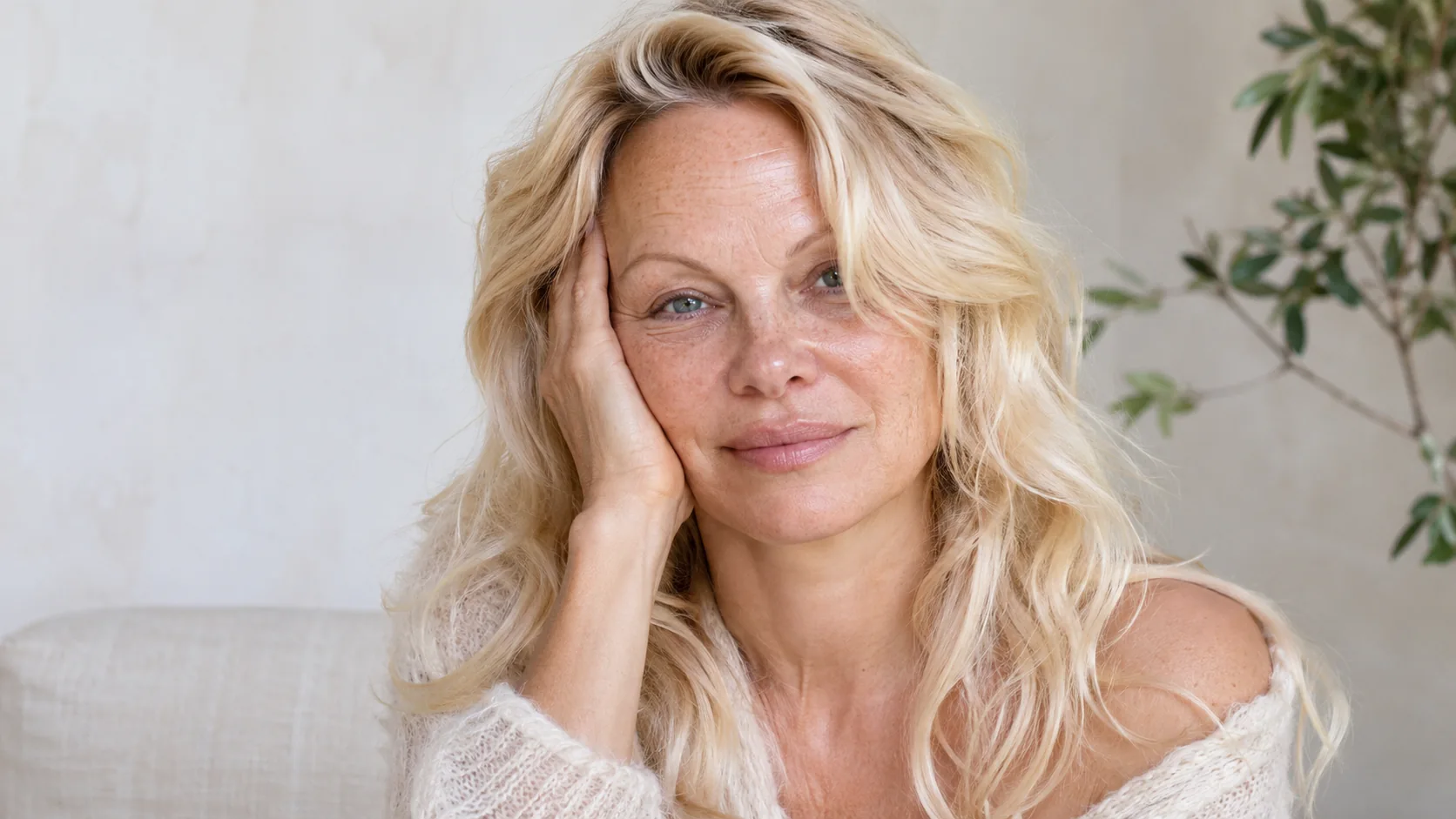
“I’m just keeping it simple,” Anderson told Vogue ahead of the 2023 Fashion Awards. She called it “a self-acceptance time of my life.” Those are descriptions of her own choices and feelings, not a prescription for anyone else.
Her position also leaves room for change. In a 2025 British Vogue interview, she said, “I’ve never been opposed to glam.” Wearing makeup on another occasion does not contradict her earlier account or prove it was insincere.
When and where did she describe her approach?
A Vogue France video followed Anderson preparing for the Vivienne Westwood show during Paris Fashion Week in 2023. Later that year, she spoke to Vogue from a London hotel room ahead of the Fashion Awards; the interview was published on December 7. British Vogue revisited her beauty choices on May 22, 2025.
These appearances offer snapshots, not a complete record of what she does on ordinary days. A photograph from an event cannot establish everything on someone’s skin—or everything they use at home.
Which brands or products is she publicly linked to?
Anderson’s connection to Sonsie is documented and commercial. A January 2024 company announcement said she joined the existing company as co-founder and owner. Vogue reported that Anderson and her sons acquired the brand and described her discovery of its Basic Balm. She later discussed using its serum and cream with British Vogue.
She also appeared in a Smashbox campaign associated with Photo Finish Primer, as discussed in a 2024 Nylon interview. A campaign is evidence of an association, not proof of everyday use or superior performance.
These links do not make her personal views invalid, but her financial relationship matters when interpreting product praise. The supplied research does not establish a comparative clinical trial showing that Sonsie products outperform alternatives. Formulations and ownership arrangements can also change.
What is speculation rather than confirmed personal information?
An Allure interviewer raised the possibility that the makeup-free appearances were a publicity stunt; Anderson rejected that characterization. The suggestion is an interpretation, not established fact. Her response is her own public account, not independent access to every motive.
The same boundary applies to guesses about procedures, providers, diagnoses, spending or private medical history. Photographs do not confirm those claims. The available material does not establish her complete private routine, and this article does not infer one.
What can cosmetic minimalism change—and what can’t it?
Using less makeup can change a person’s presentation and may reduce the time spent applying or removing it. Someone who reacts to a particular cosmetic may benefit from avoiding that product. For Anderson, the reported significance was personal: simplicity and self-acceptance.
But less makeup is not itself an anti-aging treatment, a diagnosis of healthy skin or evidence that someone has had no cosmetic treatment. Nor is makeup inherently a failure of self-acceptance. The useful distinction is between a choice about presentation and a claim about what has happened biologically.
What does evidence say about everyday sun protection?
The strongest skincare evidence in this dossier concerns sunscreen as a treatment category, not Anderson’s brand. In the Nambour randomized trial, 903 Australian adults under 55 were assigned to daily or discretionary sunscreen use. Researchers blinded to assignments graded changes in skin-surface replicas from the backs of participants’ hands; 604 had usable replicas at both time points.
After 4.5 years, the daily-use group had lower odds of an increased photoaging grade: an odds ratio of 0.76, with a 95% confidence interval of 0.59–0.98. That is not a finding that participants looked 24% younger. The comparison group could use sunscreen too, and missing measurements, a mostly fair-skinned population and an older formulation limit how broadly the result applies. Hand measurements also cannot tell us precisely what will happen to anyone’s face.
Sunscreen is not the only way to limit exposure: shade and protective clothing are practical alternatives or additions. The trial’s full report also recorded sunscreen-related contact allergy or irritation in 3% of participants. That figure belongs to the tested formulation and setting, not every sunscreen.
How should readers choose skincare without celebrity anecdotes as proof?
Start with a manageable routine and a sunscreen you can tolerate. A gentle cleanser and moisturizer may be useful if needed; neither a celebrity endorsement nor a high price establishes that a formula is better. No specific product prices were verified in the supplied research.
For a specific concern, add one treatment at a time so irritation is easier to identify. Stop a product that irritates your skin, and seek clinical advice for persistent problems or prescription treatment. A 2025 review of randomized trials found that prescription tazarotene improved coarse wrinkles versus control in its analysis: odds ratio 4.78, 95% confidence interval 1.84–12.41. Its tretinoin estimate for that particular outcome was not statistically significant.
That is not a universal product ranking: outcomes, formulations and study designs differed, and retinoids can irritate. They require individualized advice, including when pregnant or trying to conceive. More importantly, evidence about a prescription ingredient does not validate a celebrity serum or cream.
What is a realistic, accessible lesson from this story?
Permission, rather than imitation: wear makeup, less makeup or none according to your preferences. Protect exposed skin in ways you can sustain, and choose products for your own needs rather than to reproduce a public figure’s appearance. Neither a minimal routine nor an elaborate one can guarantee a particular look or eliminate aging.
What this means for you
If you enjoy makeup, there is no need to abandon it to follow Anderson’s example. If you want a simpler routine, remove steps that do not serve you rather than replacing them with a celebrity-branded collection. Consider sun protection and a tolerable basic routine first; discuss a persistent skin concern with a clinician.
The conclusion about any particular retail product would change with well-designed, independently assessed comparative studies of that product—not merely more appearances or testimonials. Likewise, more direct public disclosure could clarify Anderson’s personal choices, but it would not turn those choices into clinical evidence for everyone else.
Sources and conflicts
Anderson’s interviews document what she said, while the Sonsie announcement and Smashbox interview document commercial relationships. Those sources do not independently establish product effectiveness or her complete private routine.
The Nambour trial received Australian public research funding and support from cosmetics and vitamin companies; its authors reported that funders had no role in study conduct or reporting. The 2025 topical-treatment review received Chinese public research funding. Its ingredient-level findings should not be confused with proof for Sonsie or another retail brand. This dossier-based assessment is bounded, and linked accounts have not been independently fact-checked here.
Sources and further reading
- Pamela Anderson on her minimalist era at the Fashion Awards, December 7, 2023
- Vogue France: Getting ready for Vivienne Westwood
- Pamela Anderson on ditching makeup, February 8, 2024
- Pamela Anderson on her beauty choices, May 22, 2025
- Sonsie Skin announcement, January 22, 2024
- Pamela Anderson acquires Sonsie, January 22, 2024
- Pamela Anderson and the Smashbox campaign, February 15, 2024
- Sunscreen and prevention of skin aging: a randomized trial
- Nambour trial full text
- Comparative efficacy of topical interventions for facial photoaging, 2025
A source shows where a claim comes from; it does not automatically prove that the claim is true.
Spotted something that needs correcting? Contact the editorial team.
Related reading
Lindsay Lohan’s skincare: what she said, what remains rumor and what treatments cost
Her own comments offer a narrower picture than the speculation. Here is what the evidence says about her disclosures, treatment risks and generic US costs.
4 November 2026
Can a skin cream really reverse its biological age? The early RLS-1496 story
A small experimental study reported changes in skin-age biomarkers. Those numbers are not proof that wrinkles disappeared or that people became younger.
4 November 2026
Exosome facials: promising research, unanswered safety questions
Small human studies offer early clues, but they do not establish that an exosome facial is a reliable anti-aging treatment.
4 November 2026