

Vitamin C serums for mature skin: what the evidence and price can tell you
Small controlled studies suggest some vitamin C mixtures can improve measures of photodamage. They do not establish that a particular retail serum is worth its price.
In 30 seconds
Small controlled studies found improvements in some measures of photodamage with topical vitamin C mixtures, but they did not test every retail serum. In one trial, photographs improved on 11 of 19 vitamin C-treated facial sides versus two vehicle-treated sides after three months. Stinging and redness were reported. Formulation matters; a higher percentage or price alone does not establish better results.
Reader questions answered
What skin outcomes have controlled topical vitamin C studies measured?
Studies in this dossier measured clinical signs of photodamage, photographs and skin-surface replicas. These assess changes in appearance or skin texture; they do not show that a person has become biologically younger.
In a 1999 randomized, blinded split-face study, 28 adults enrolled and 19 were included in the efficacy analysis. The evaluable participants were aged 36–72 and had mild-to-moderate facial photodamage. Each used the active preparation on one side of the face and a matched inactive vehicle on the other. Comparing sides helps control for differences between people, though it does not eliminate every source of bias.
After three months, blinded photographic ratings found 11 of the 19 active-treated sides improved or slightly improved, compared with two of the 19 vehicle-treated sides. Eight active-treated sides were rated unchanged. The active preparation also contained zinc and tyrosine, so the result cannot be attributed to vitamin C alone. Nine enrolled participants were not included in the efficacy analysis, and the evaluable participants had Fitzpatrick skin types I–III. The study cannot establish results across all skin tones or durability over years.
A second double-blind, half-face study compared a combination vitamin C gel with an inactive polysilicone gel in 10 patients. Cheek and perioral photoaging scores improved significantly on the treated side, with reported p values of 0.006 and 0.01, respectively. Those values describe the statistical comparisons, not how large or personally meaningful the visible changes were.
What formulation types and concentrations have actually been studied?
L-ascorbic acid is one form of vitamin C; tetrahexyldecyl ascorbate is a different derivative. A percentage tells you how much of the named ingredient is in a formula, not how much reaches the skin or what visible result it produces. Equal percentages of different forms are not automatically equivalent.
The 10-patient study tested an anhydrous gel containing 10% ascorbic acid and 7% tetrahexyldecyl ascorbate together. It cannot assign the observed improvement to either ingredient separately. This example does not establish an optimal concentration range or show that a stronger serum will work better for a particular person.
A 2026 systematic review included 44 studies published from 2020 onward and emphasized formulation and delivery. It combined different delivery routes and indications, so its findings are not a direct comparison of over-the-counter facial serums.
Does packaging prove a serum will stay effective?
No. Pure vitamin C is unstable in water, and formulation, exposure to air and light, and storage can affect stability. The review’s emphasis on formulation and delivery is a reason to ask for product-specific data, not a substitute for them.
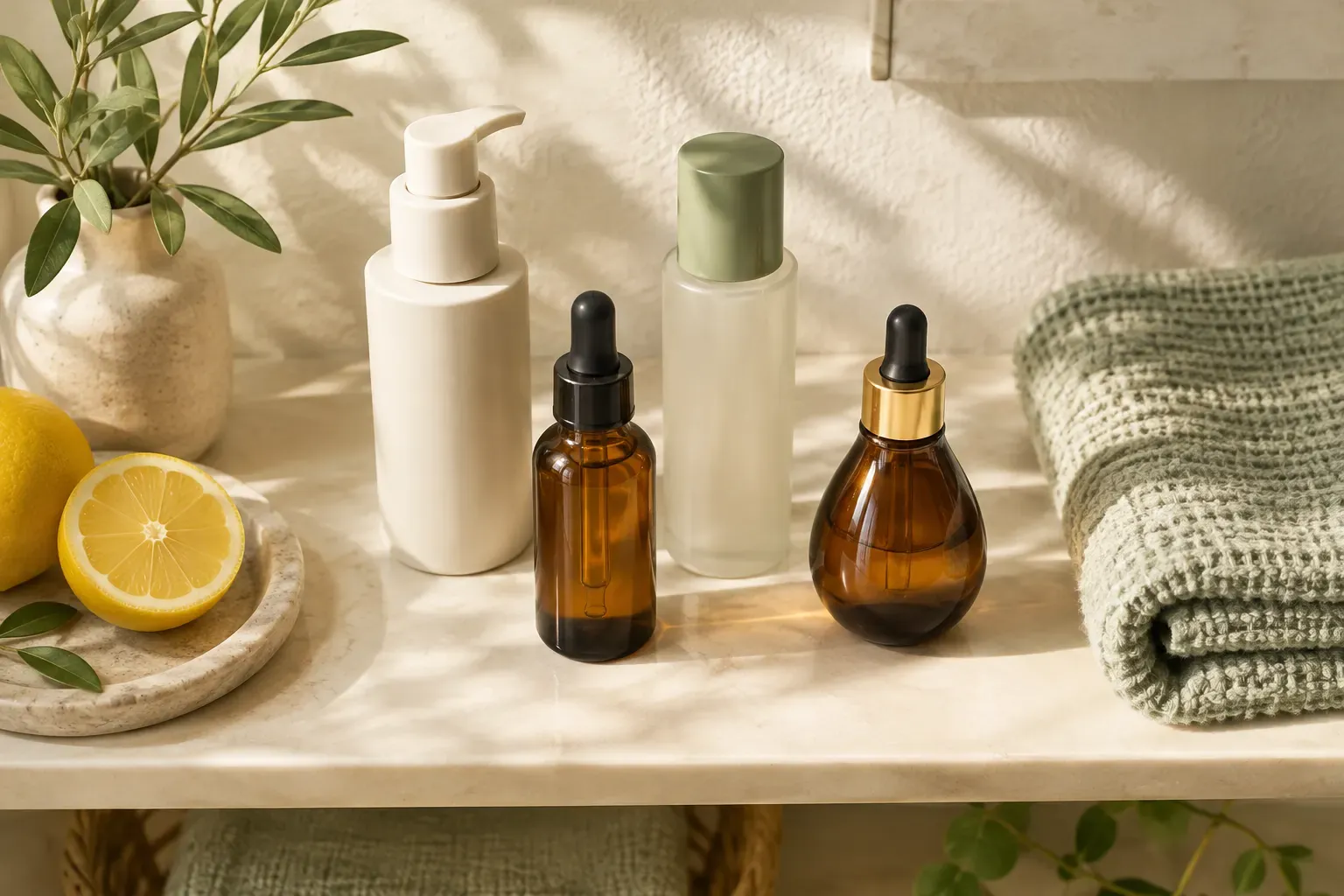
An opaque bottle, dropper or pump alone cannot establish how much active ingredient remains during shelf life or after opening. Color alone cannot reliably quantify remaining potency either. Read the manufacturer’s storage and after-opening directions and close the container promptly. The dossier does not provide independently measured remaining active concentrations during typical home use of the featured serum.
Can vitamin C cause irritation, and who should be cautious?
Yes. In the 1999 study, 11 participants reported stinging, five reported erythema, or redness, and one reported dry skin. Because each participant used both active and vehicle, the report does not provide a clean active-versus-vehicle irritation rate that can be transferred to modern products.
If your skin is sensitive, irritated or damaged, be especially cautious. Patch-test, introduce one new product gradually and stop if irritation persists. Seek professional advice if a reaction is concerning. A simple moisturizer or skipping the serum altogether is reasonable; a cosmetic ingredient is not worth persistent discomfort. A vitamin C derivative is not guaranteed to be gentler for every person.
Which current US product discloses verifiable formulation details?
The SkinCeuticals C E Ferulic US listing identifies 15% L-ascorbic acid, 1% vitamin E and 0.5% ferulic acid. The page describes an enhanced formula.
That company listing is useful for identifying what the manufacturer says is in the product. It is not independent proof that this exact current formula outperforms another serum or will reproduce the results of a different mixture studied years ago. Check the full ingredient list and storage directions as well as the headline concentration. Other current US products may disclose useful details, but comparing them here requires additional verified sources.
What is its published price per volume, and when was it recorded?
The dossier records the manufacturer’s US listing at $185 for 30 mL, or approximately $6.17 per mL, with a source check dated November 4, 2026. This is the listed bottle price before tax, shipping or promotions; check the current listing before buying.
Price per milliliter helps compare the cost of liquid, not the cost of a visible result. Cost per use also depends on how much you apply, how often and whether you finish the bottle while it remains usable. The dossier does not establish that this serum’s price buys a better clinical outcome than a less expensive alternative. A verified comparison price for another product would require further sourcing.
How can readers separate marketing language from evidence?
Ask four questions:
- Was the exact current formula tested? A result for a different vitamin C mixture does not automatically validate a branded bottle.
- Was there a control in people? A blinded comparison with an inactive vehicle helps distinguish the treatment effect from other changes.
- What changed, and by how much? A photograph rating, clinical score and laboratory antioxidant claim answer different questions. Statistical significance alone does not establish a dramatic visible benefit.
- Who supplied or funded the work? A relationship does not automatically invalidate a study, but it matters when weighing independence and replication.
The 2026 review supports looking at formulation and delivery, but its heterogeneous studies do not establish a winner among retail serums. The company page describes an enhanced formula; the dossier does not establish whether that exact formula has an independently replicated controlled trial supporting its specific years-reversed claim. Ask for that evidence rather than treating the claim as a measured outcome.
When should sunscreen come before a serum?
If money, time or skin tolerance is limited, prioritizing sun protection over an optional cosmetic serum is a sensible choice. The vitamin C studies here examine signs of photodamage; they do not show that a serum replaces sunscreen.
The important limit is that this dossier does not include a sunscreen trial or guideline. It cannot quantify sunscreen’s benefit against the featured serum or support a detailed sunscreen specification. A separate evidence review would be needed for a rigorous comparison. For now, treat vitamin C as optional, not a substitute for sun protection.
What this means for you
Start with an achievable goal, such as a modest change in the appearance of photodamaged skin, rather than a promise to reverse age. If you try a serum, compare the named vitamin C form, concentration, complete ingredient list, storage directions and price per milliliter. Choose a price you can accept without assuming that the most expensive product has been independently shown to work best.
Introduce it cautiously and judge results over a realistic period rather than expecting an immediate transformation. Stop if irritation persists. If your skin is already uncomfortable, a simple moisturizer and no vitamin C serum are reasonable alternatives.
What would change the conclusion? Larger, independently replicated, blinded trials of exact current retail formulas—against appropriate vehicles and each other—would help. They should include diverse skin tones, report the size and duration of visible changes and harms, and disclose funding. Independent measurements of stability after opening would also make packaging claims more useful. Until then, the evidence supports cautious interest in some formulations, not a definitive retail winner.
Sources and conflicts
- The 1999 split-face study was funded by an institute research fund. Cellex-C supplied the preparations and participant completion incentives; the author denied a financial relationship.
- Funding for the 2002 combination-gel study was not verified from the accessible abstract.
- The 2026 systematic review combines heterogeneous studies and delivery routes. One author disclosed consulting relationships including L’Oréal/Vichy.
- The SkinCeuticals listing is a company source for product details and listed price, not independent comparative proof of efficacy or stability.
- The dossier was web-cited but not independently fact-checked. Its corrections and retractions check was not comprehensive; the absence of a noted correction is not proof that none exists.
Sources and further reading
- Use of Topical Ascorbic Acid and Its Effects on Photodamaged Skin Topography
- Double-blind, half-face study comparing topical vitamin C and vehicle
- Clinical Applications of Vitamin C in Dermatology: A Systematic Review
- C E Ferulic with 15% L-Ascorbic Acid
A source shows where a claim comes from; it does not automatically prove that the claim is true.
Spotted something that needs correcting? Contact the editorial team.
Related reading

Collagen supplements and younger-looking skin: what human trials actually show
Some controlled trials find improvements in hydration and wrinkle ratings, but the most reliable evidence leaves visible benefits uncertain.
4 November 2026

Biological age tests: what your DNA age number can and cannot tell you
A test might call you 48 when your calendar says 55. But that number is not a diagnosis, and it doesn't prove you have added years to your life.
4 November 2026
Can an LED face mask improve wrinkles?
Small human trials offer some encouragement, but they do not prove that every mask works—or that changes last.
3 November 2026