

Biological age tests: what your DNA age number can and cannot tell you
A test might call you 48 when your calendar says 55. But that number is not a diagnosis, and it doesn't prove you have added years to your life.
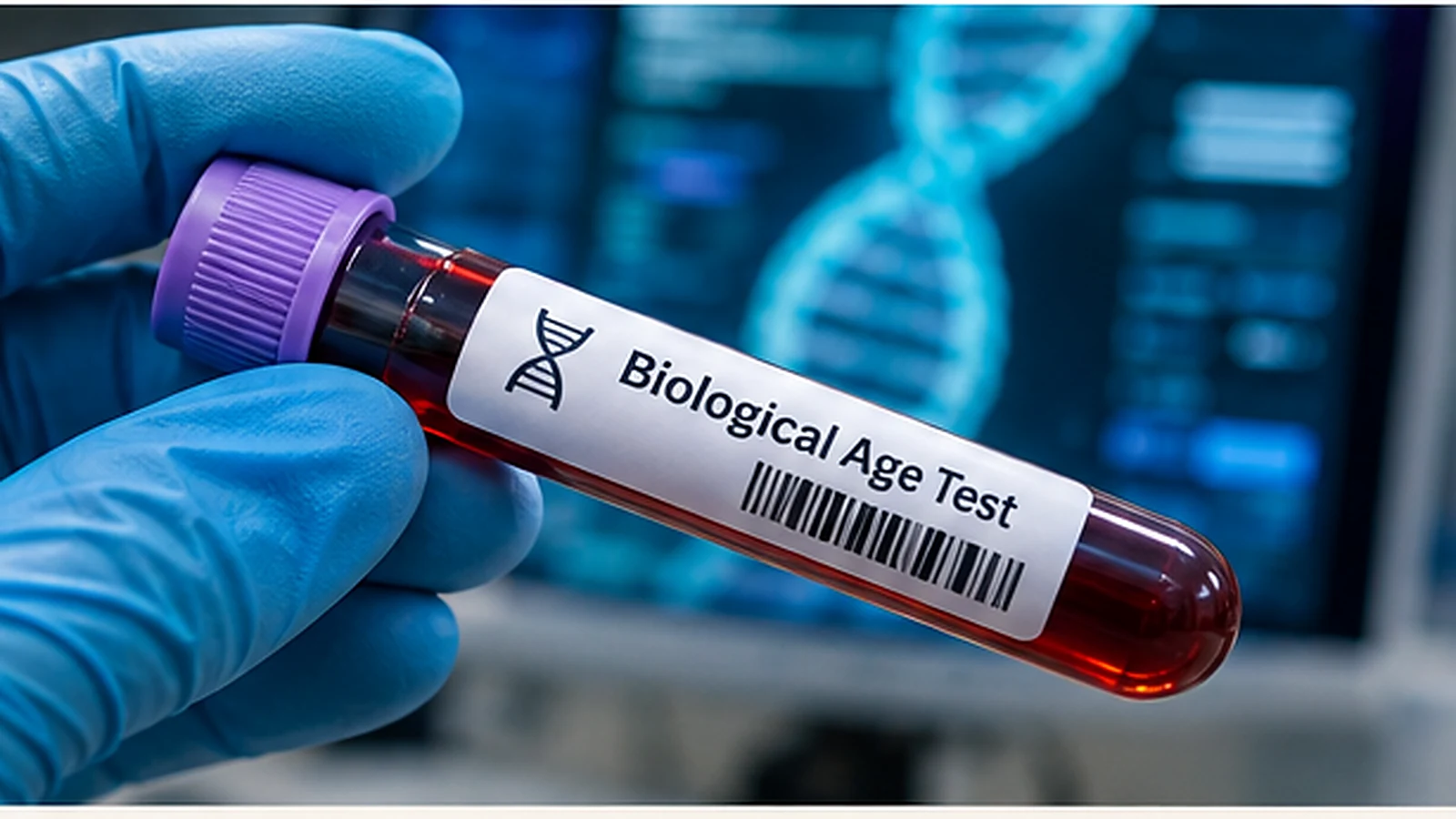
In 30 seconds
- Some tests look at chemical markers on your DNA and use a computer model to estimate your 'biological age'.
- These tools can be useful for research across large groups of people.
- An individual score can change because of how a sample was taken, what model was used or normal biological variation.
- A younger-looking result does not prove a treatment worked, that your health improved or that you will live longer.
- Before paying, ask what decisions the test could actually help you make.
What happened
Imagine you're 55 years old, but a laboratory report says your biological age is 48. It's tempting to see this as seven years of life gained.
The number is not that simple.
One popular method uses DNA methylation. That's a name for small chemical tags associated with DNA that help scientists study patterns in how genes are regulated. Researchers have found that some of these patterns change with age.
In a landmark 2013 research paper, Steve Horvath described a mathematical 'clock' that estimates age from these patterns across different human tissues. Other researchers have since developed many different clocks designed to predict calendar age, health-related outcomes or how quickly certain ageing-related patterns change.
These methods have made important contributions to science. They can help researchers compare groups and investigate why ageing patterns vary.
The complication begins when a research tool is sold as a personal report card.
What the evidence supports
The US National Institute on Aging has described how DNA-based age measurements may help predict health outcomes in populations. But its 2024 summary also notes that information about everyday behaviours, social circumstances and other health factors can be just as useful—and often more useful—for understanding outcomes.
A scientific analysis published in December 2025 argues that technical differences in sample collection, laboratory processing, algorithms and the biology of DNA methylation currently limit the use of these clocks for individual clinical decisions. This is the authors' critical interpretation, not a formal ruling that every kind of biological-age research is invalid.
The key distinction is prediction versus proof. A marker may be associated with future health outcomes without becoming a reliable target for treatment or a guarantee about what will happen to one person.
What should a buyer ask?
If you're considering a commercial age test, investigate the exact test, not just the science behind the category.
- What does it measure? DNA methylation, blood proteins or something else?
- Which clock does it use? Different algorithms may produce different estimates.
- How consistent is it? Would a repeat sample soon afterwards give a similar answer?
- What was validated? Predicting the average age of a study group is not the same as reliably guiding one person's care.
- What would you change? If the provider cannot explain a useful, evidence-supported next action, the result may be mainly interesting rather than actionable.
- What happens to your data? Check whether the lab stores your biological sample or raw genetic-related data, who can access it, whether it may be shared or sold, and how deletion requests work. Sensitive information deserves more care than an ordinary shopping account.
We have deliberately not named or ranked commercial tests here. We have not verified current product prices, laboratory accreditation, review authenticity or the clinical performance of specific brands. Those details belong in a separate, product-by-product comparison.
What we still do not know
Researchers continue to develop and evaluate biological-age measures. Future tests could become more useful for individual decisions; some current clocks already help researchers compare populations. But a high correlation with age in a study does not establish reliable personal diagnosis or prove that every commercial test can guide treatment.
A person receiving a 'younger' reading after a lifestyle change cannot conclude that the change extended their lifespan. Even when a measurement changes, it may not track meaningful improvement in disease, mobility or survival.
What this means for you
A biological-age result may be interesting, especially if you enjoy following scientific progress. Treat it as a conversation starter, not a medical verdict.
Do not stop treatment, change medication or spend heavily on a programme simply because a commercial clock says your number went up or down. For medical concerns, talk to a qualified professional who can interpret established clinical measurements alongside your history.
Why we chose to cover this category
Biological-age testing is a visible consumer longevity category and raises a central buying question: Does an interesting measurement provide useful information for its price? We selected the category because readers encounter the claim frequently, not because we have decided any brand is the best or cheapest.
Sources and conflicts
The original DNA-clock paper and subsequent research are scientific sources. The National Institute on Aging summary supplies independent context, while the 2025 analysis provides an explicitly critical interpretation. We have not compared commercial providers or their financial relationships. A later brand comparison would need dated price and specific validation checks.
Sources and further reading
- Horvath — DNA methylation age of human tissues and cell types (2013)
- NIH National Institute on Aging — DNA-based age and health outcomes (2024)
- Apsley et al. — limits of epigenetic clocks as personal biomarkers (2025)
A source shows where a claim comes from; it does not automatically prove that the claim is true.
Spotted something that needs correcting? Contact the editorial team.
Related reading

Mouse, marker or lifespan? Four questions that make longevity headlines clearer
A dramatic result in a mouse or a biological-age score can be worth studying. It doesn't automatically mean people will live longer. Here's a quick way to tell the difference.
4 November 2026

XPRIZE Healthspan: 20 finalists, a $101 million prize and a very big question
The competition wants therapies that improve muscle, thinking and immune function in later life. Its 2026 finalists are a milestone for research—not proof that an age-reversal treatment works.
4 November 2026
Sunscreen, retinoids and vitamin C: what really helps ageing skin?
A look at three popular skincare ingredients, the difference between prevention and treatment, and why more expensive does not always mean better supported.
4 November 2026