

AI skin-age analysis apps: how reliable are smartphone ageing estimates?
A selfie can produce a convincing-looking number. Research offers less reason to treat it as a measurement of how your skin is ageing.
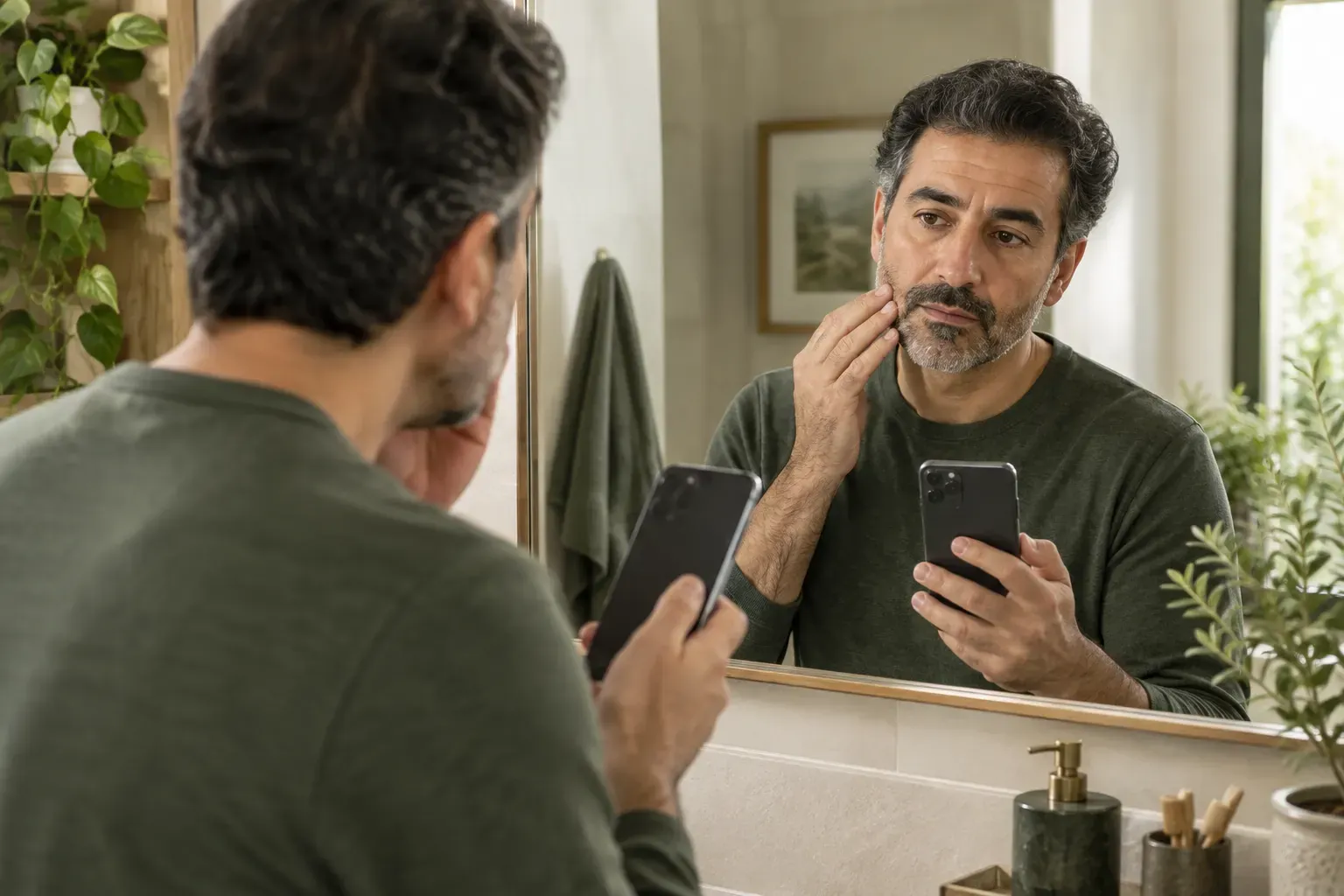
In 30 seconds
AI skin-age apps turn selfies into apparent ages and scores for visible features. A review of 27 studies found prediction errors varied widely across research models; it did not validate a particular retail app. Small studies also show imperfect agreement with dermatologist ratings of individual features. Capture conditions and representation matter, as do privacy and subscription terms. Treat a skin-age number as an unverified appearance estimate, not a diagnosis.
Reader questions answered
What do AI skin-analysis apps claim to measure?
Apps may offer an apparent skin age alongside scores for visible features such as wrinkles, pigmentation, texture, pores or redness. Some systems infer hydration or skin type and suggest routines. The Skinify website advertises facial skin scanning and personalised product recommendations, but the public page reviewed did not establish that it supplies a numerical skin-age estimate. It is an example of a commercial skin-analysis app, not a verified example of skin-age scoring.
Definitions differ by product. A score labelled “moisture” should not automatically be read as a direct measurement of water in the skin. Training data and the influence of any age you enter may not be disclosed.
How accurate are they under independently described validation?
The evidence reviewed does not establish the accuracy of the named consumer apps’ skin-age numbers. A 2025 systematic review included 27 studies and reported mean absolute errors of 2.30–8.16 years across different models. That is not a pooled error for smartphone apps: the models and reference measures differed, and some used non-image biomarkers. A mean also does not set a limit on any one person’s error. Many studies had a high risk of bias.
A separate case series compared AI ratings with one dermatologist’s ratings on 46 clinical facial photographs, covering 14 appearance parameters. Of 644 ratings, 37% matched exactly and another 46% differed by one grade. Average intraclass correlation, a different measure of agreement, was 0.41; it varied from 0.05 for moisture to 0.74 for wrinkles. There was no independent second dermatologist as a comparator. Importantly, the authors disclosed that the application displayed inflated patient-facing scores intended to improve users’ self-image, highlighting why a polished app score should not be interpreted as an objective scientific measurement. This study tested feature grades, not whether an estimated age in years was correct.
These studies show what research systems can do under particular conditions. They are not independent validation of a current retail app.
Do they perform equally across skin tones and ages?
That has not been demonstrated. The 46-photo case series included people with estimated ages of 10–79, but few older participants and nobody assigned Fitzpatrick skin type VI. A larger study included 1,099 Korean participants aged 14–69 at one centre; those findings cannot establish consistent performance across global populations and camera settings.
These are evidence gaps, not proof of a particular group’s error. Useful product-specific evidence would report how many people were tested and the error for each age and measured skin-tone group, rather than relying on one overall average.
How much does lighting and image quality affect the results?
They can affect what a model sees, but the evidence cannot translate a lighting change into a fixed number of skin-age years. In the 1,099-person study, the model exactly matched dermatologist-assigned grades in about 51% of DSLR test-image assessments on average. The published 58.7% and 50.5% figures refer to forehead and cheek pigmentation, respectively—not DSLR versus mobile cameras. The researchers also assessed images from phones and tablets, with performance varying by feature and capture method. This single-centre study did not validate a commercial skin-age number or independently test the model on a wholly separate external population.
If you choose to compare personal photos, use the same phone, position and expression in consistent, even lighting, without filters. Repeat a scan before interpreting an apparent change; avoid treating the repeat result as a health measurement. Consistency may reduce avoidable variation; it cannot make an unvalidated score accurate.
What personal data do apps collect or retain?
Practices differ. Some apps may retain or process facial images. The current retention, deletion and sharing terms of the named app have not been independently verified; check the actual current policy before uploading. A company privacy claim is not an independent audit.
Check an app’s current policy and permissions before uploading. Backup retention, processor access, deletion timing and actual compliance were not independently verified here. Further sourcing is required to assess other apps’ disclosures and practices.
What does a higher estimated skin age actually tell a consumer?
It means the app judged the photographed face to look older according to its model and reference, if that is how the product defines its score. It does not establish accelerated biological ageing, disease, lifespan or a need to buy treatment. A one-year change can imply more precision than the evidence supports: repeat-scan variation under home conditions is unknown for the named apps. Neither the skin-analysis app description nor the research review establishes that a commercial skin-age score predicts future skin outcomes or treatment benefit.
A concerning score can prompt unnecessary worry or purchases; conversely, a reassuring score should not replace assessment of a concerning lesion.
How do free tools compare with verified paid subscriptions?
Current free-versus-paid prices, specific app entitlements and recurring charges were not reliably verified. Check the live app-store terms, cancellation process, taxes and renewal conditions before subscribing.
Paying buys access or features—not demonstrated superior accuracy. The evidence reviewed contains no independent head-to-head validation of paid and free tools. Further sourcing is required to compare other apps’ current prices and terms.
What independent skincare or medical alternatives could be more useful?
For a specific concern, ordinary consistent photographs can provide a record without turning appearance into an age score. A simple routine can focus on sun protection, gentle cleansing and moisturizer. For a changing, bleeding, itchy, painful or persistent lesion, consult a qualified clinician rather than relying on an app.
In the US, the FDA’s general-wellness guidance does not itself establish a product’s safety or effectiveness or determine the status of a particular app. An app’s wellness presentation is not evidence that it can diagnose a skin condition.
What this means for you
If you enjoy the novelty, decide whether the selfie and any subscription are worth sharing before scanning. Compare photographs, not tiny changes in an age number, and avoid buying a regimen solely because an app says your skin looks older.
A more persuasive result would come from independent testing of the current retail app on an external group, with repeat scans, clear reference measures and errors reported across skin tones, ages and phones. Evidence that scores predict meaningful future outcomes or treatment benefit would also change what the number can reasonably tell a consumer.
Sources and conflicts
The evidence combines a systematic review, two research studies, a company disclosure and US guidance. The case-series paper says Perfect Corp. supplied model access and funding, but also states that no funding or sponsorship was received; that contradiction remains unresolved. The larger Korean study lists research grants in its indexed publication record and includes authors affiliated with a commercial AI company; those ties are relevant context, not proof of an incorrect result. Company descriptions are not independent proof, and the evidence check was not exhaustive.
Sources and further reading
- Machine learning methods for determining skin age: A systematic review
- Skin Parameter Scoring Using Artificial Intelligence: A Case Series
- Artificial Intelligence Based Skin Analysis Models for Predicting Visual Grades and Device Measured Physiological Values From Facial Images
- Skinify skin age test
- General Wellness: Policy for Low Risk Devices
A source shows where a claim comes from; it does not automatically prove that the claim is true.
Spotted something that needs correcting? Contact the editorial team.
Related reading
At-home red light panels and face masks: what do the dose numbers actually mean?
Wavelength, power and treatment time describe different things. Here is how to read the numbers without mistaking a promising study for proof that every device works.
5 November 2026
Glucose monitors without diabetes: useful insight or another expensive number?
Over-the-counter sensors can show how glucose changes during the day. That is not the same as proving better health in people without diabetes.
4 November 2026

XPRIZE Healthspan: 20 finalists, a $101 million prize and a very big question
The competition wants therapies that improve muscle, thinking and immune function in later life. Its 2026 finalists are a milestone for research—not proof that an age-reversal treatment works.
4 November 2026