

At-home red light panels and face masks: what do the dose numbers actually mean?
Wavelength, power and treatment time describe different things. Here is how to read the numbers without mistaking a promising study for proof that every device works.
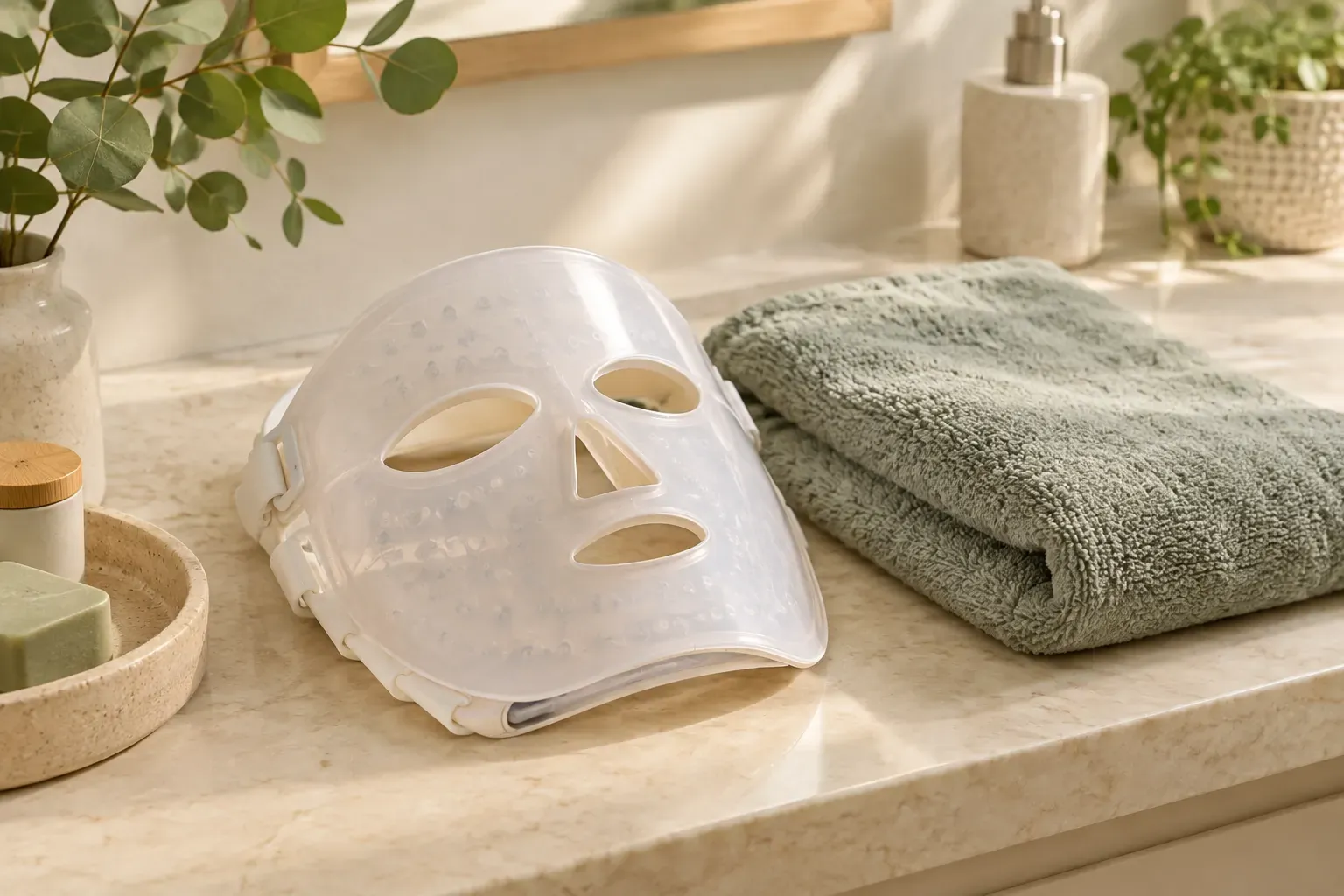
In 30 seconds
Red-light devices are being studied for cosmetic skin changes, not proven longevity benefits. In a sham-controlled trial of 95 women, a 660-nanometer mask produced statistically significant changes in some wrinkle-length measurements over four weeks, but the abstract does not establish a useful absolute effect size. To compare devices, look for light output measured at the skin and treatment time—not LED count. A study of one mask does not validate every panel or retail brand.
Reader questions answered
What might red and near-infrared light do in skin?
Researchers propose that light influences cellular signaling, including pathways involving light absorption in mitochondria, with possible effects on inflammation and fibroblast activity. Those mechanisms are still under investigation. They do not establish that a particular device reliably rebuilds collagen, slows biological aging or extends life. The relevant question for a buyer is whether the finished device produces a meaningful, safe result in people—not whether a mechanism sounds plausible. At-home evidence review
What do controlled human studies actually measure?
The randomized, sham-controlled mask trial enrolled 95 women aged 45–60. Active groups used a red-light mask twice or three times weekly for four weeks; the sham group used an inactive treatment twice weekly. Researchers used blinded ratings of standardized photographs and image analysis. Compared with sham, the active groups had statistically significant reductions in measured wrinkle length between the eyebrows and around the right eye.
That is evidence of a measured cosmetic change, not a clear promise of a noticeable transformation. The accessible abstract does not give an interpretable absolute between-group change, and the trial does not establish durability or effects in men. An at-home review identified eight studies with 365 participants, but their devices and protocols differed; the accessible abstract does not provide a single pooled effect size.
How can I compare wavelengths and dose numbers?
Wavelength, given in nanometers (nm), describes the light. The controlled mask trial used 660 ± 10 nm. Irradiance, in milliwatts per square centimeter (mW/cm²), describes optical power reaching an area. Fluence, in joules per square centimeter (J/cm²), describes energy delivered per area over time.
For constant output, fluence = irradiance × seconds ÷ 1,000. The trial reported 6.4 mW/cm² for 21 minutes: that calculation gives about 8.06 J/cm², close to its reported 8.05 J/cm² per session. Trial record
Ask a seller for peak wavelengths and bandwidth, irradiance at the actual skin position, measurement distance, coverage uniformity and calibration method. Also ask whether output is combined or wavelength-specific, and whether a pulsed device reports average output. Electrical input watts and LED count are not skin-level dose. A calculated surface dose is not necessarily the amount absorbed by tissue; more is not proven better.
Is a face mask better than a full panel?
A mask sits close to the face and may make positioning repeatable, although fit and gaps can change local exposure. A panel can cover a larger area, but distance, angle and coverage affect the light reaching skin. Neither format is inherently more effective or safer. Compare measurements at the intended position, instructions and studies of the actual model. A directly controlled mask-versus-panel comparison at matched skin doses was not established in this review. Mask trial
What should a regulatory claim establish?
In the United States, check the manufacturer, exact model, 510(k) number and cleared indication in FDA records. The FDA lists an over-the-counter wrinkle-reduction light-device category as Class II with a 510(k) pathway; that category listing does not clear every product in it. FDA classification
For example, an FDA clearance summary covers specified eye-device models for wrinkles around the eyes. It describes substantial equivalence for that indication—not FDA approval, a guarantee of results, or proof of whole-body longevity claims. Registration, listing and a CE mark are not interchangeable with U.S. clearance.
What about eyes, heat and medications?
Follow the exact device’s eye instructions and use supplied or specified protection where required; do not stare into LEDs. Near-infrared light can be invisible, so an absence of visible brightness does not prove eye safety. The cleared eye device above includes goggles, but its instructions should not be assumed to apply to another model. FDA device summary
Stop for pain, excessive heat, burns, visual symptoms or persistent irritation. Ask a clinician before use if you have an eye condition, a light-sensitive disorder or take potentially photosensitizing medication; do not stop a prescription on your own. The at-home review reported adverse events as infrequent, mild and transient, but long-term safety evidence was limited. Review
When can’t a published result be applied to a home device?
Be cautious when a study differs in device, wavelength mix, skin-level irradiance, exposure time, schedule, body site or population. An in-office result does not automatically apply to a home panel, and a category-level review does not prove a retail brand works.
The distinction matters for combined treatments. A mask-and-cream study reported a 24.2% reduction from baseline in investigator-assessed crow’s-feet wrinkle depth at day 56. But the combined intervention and baseline comparison do not isolate what the mask contributed; its sample size and control details were not verified here. That percentage is not equivalent to the sham-controlled trial’s wrinkle-length result.
What if I would rather spend less?
A device is optional. Prioritize regular sun protection and a basic moisturizer, and discuss a topical retinoid with a clinician if appropriate for your goal and skin; retinoids can irritate and are not suitable for everyone. Further sourcing would be needed for direct comparisons between those options and a specific light device. No current device prices or cost-effectiveness comparisons were verified. If shopping, consider the total cost, return policy and replacement parts—not LED count alone.
What this means for you
Treat a panel or mask as an optional cosmetic purchase with uncertain product-specific benefits. Before buying, match the exact model and indication to its regulatory record, then ask whether its skin-level output and schedule resemble those in a controlled study. If the seller cannot substantiate the dose at the intended position, the headline numbers offer limited guidance.
Larger, longer sham-controlled trials across more skin phenotypes, with clinically interpretable between-group changes and verified device measurements, could strengthen or weaken the case. Direct comparisons at matched doses would also help establish whether format matters.
Sources and conflicts
The sources include a short sham-controlled trial, an at-home evidence review and FDA records; they address different questions. The review authors declared no conflicts of interest, but funding for the individual 2025 trial was not verified, and included studies may have different conflicts. Publication amendments or corrections for the pivotal trial were not conclusively checked. This was a bounded research review, not an exhaustive systematic review; retail prices and current device-specific safety alerts were not verified.
Sources and further reading
- Role of photobiomodulation application frequency in facial rejuvenation
- Efficacy and Safety of At-Home LED Photobiomodulation for Facial Rejuvenation
- Anti-Aging Efficacy of a Home-use Red and Infrared LED Mask and a Cream
- FDA product classification: light-based over-the-counter wrinkle reduction
- FDA 510(k) K221444: LED Eye Perfector
A source shows where a claim comes from; it does not automatically prove that the claim is true.
Spotted something that needs correcting? Contact the editorial team.
Related reading
AI skin-age analysis apps: how reliable are smartphone ageing estimates?
A selfie can produce a convincing-looking number. Research offers less reason to treat it as a measurement of how your skin is ageing.
5 November 2026
Glucose monitors without diabetes: useful insight or another expensive number?
Over-the-counter sensors can show how glucose changes during the day. That is not the same as proving better health in people without diabetes.
4 November 2026

XPRIZE Healthspan: 20 finalists, a $101 million prize and a very big question
The competition wants therapies that improve muscle, thinking and immune function in later life. Its 2026 finalists are a milestone for research—not proof that an age-reversal treatment works.
4 November 2026