

Dark circles, eye bags and under-eye hollows: what actually works for each
The right treatment depends on whether you are seeing pigment, swelling, a persistent bulge or a shadow—and more than one can be present.
In 30 seconds
Under-eye darkness is a description, not a diagnosis: pigment, visible vessels and shadows from hollows or bags can coexist. Temporary puffiness can fluctuate; a protruding fat pad generally persists. Human topical studies exist, but accessible evidence does not establish a reliable product ranking or typical improvement. Filler can soften selected hollows but carries uncommon, potentially devastating risks. Surgery can address selected structural bags, not reliably erase pigment. The best first step is matching the concern to its cause.
Reader questions answered
Why do dark circles have different causes?
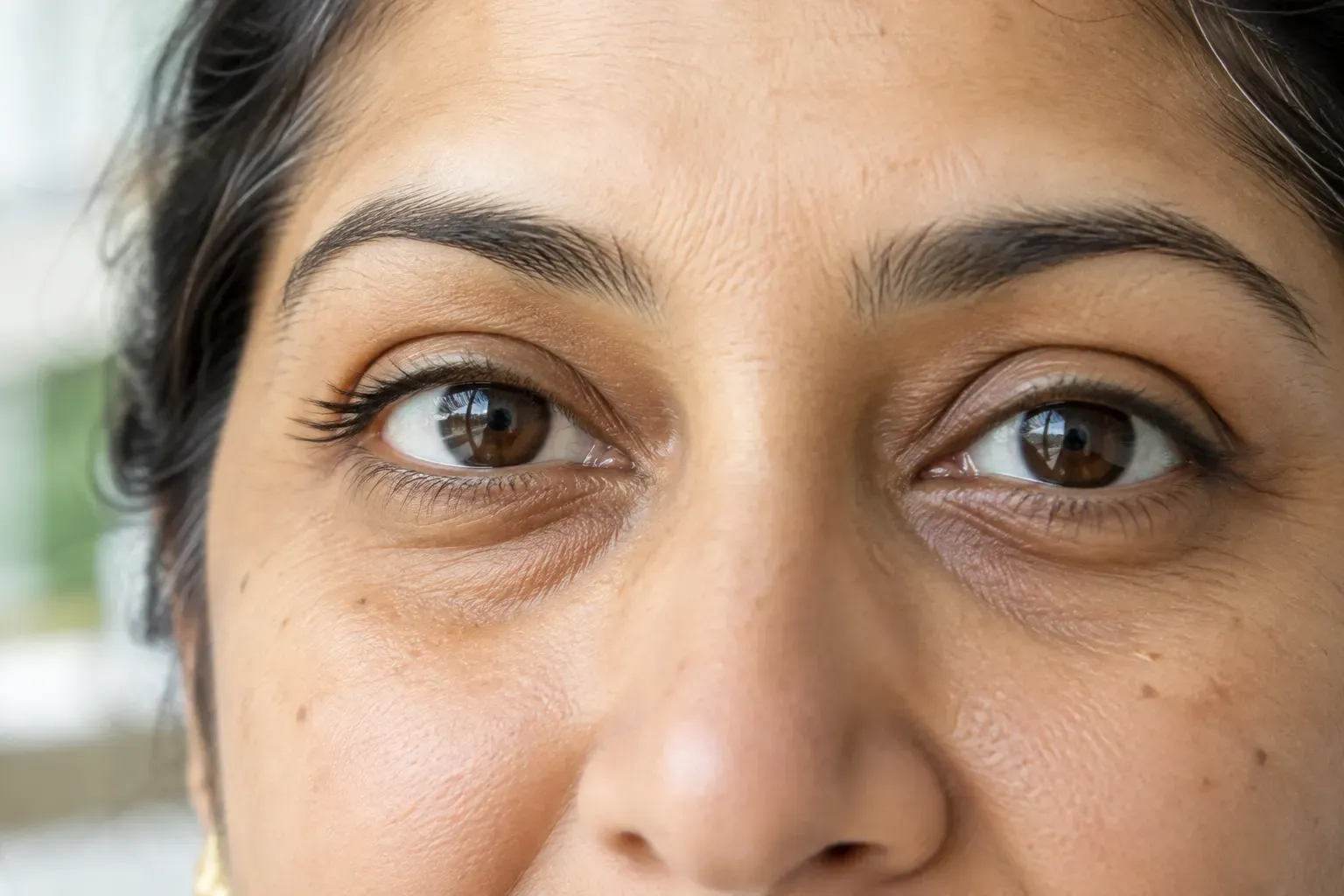
Look closely at what you mean by a dark circle. Brown pigmentation is color in the skin. Vessels showing through thin skin can contribute another kind of darkness. A hollow can look dark because it catches less light; a projecting bag can cast a shadow onto the area below it. These mechanisms can overlap, so one person may have both discoloration and a contour shadow.
Lighting is a useful clue, not a diagnostic test. If the appearance changes markedly when the direction of light changes, contour may be contributing. If color remains visible in different lighting, pigmentation or visible vessels may also be involved. Neither observation establishes a diagnosis, and a photograph alone can exaggerate or conceal shadows.
This distinction matters because treatments target different things. A product intended for discoloration cannot be expected to remove a fat pad. Adding volume to a hollow does not directly treat brown pigment. The systematic review of treatments for hyperpigmentation in darker skin addresses one part of this problem, while the American Academy of Ophthalmology’s eyelid-filler overview describes a volume-based approach to another. The review’s accessible record does not provide treatment-specific results, so it cannot tell us which option works best.
How can I tell temporary puffiness from an actual eye bag?
Temporary puffiness is swelling that can vary with fluid shifts or allergies. An actual lower-lid fat pad is a structural bulge that generally remains visible rather than disappearing as swelling subsides. Both can be present at once, and a persistent bulge can make an adjacent hollow look darker by casting a shadow.
Notice whether the area changes over time and whether allergies seem to coincide with swelling. A persistently projecting area is a reason to ask about anatomy rather than assuming that an eye cream or more sleep will flatten it. Still, appearance alone may not distinguish fluid, fat and other causes. An examination can clarify what is contributing; the Academy’s lower-eyelid surgery resource discusses assessment and approaches for selected patients with protruding fat.
A new, one-sided or worsening swelling deserves clinical assessment rather than cosmetic experimentation. Seek urgent assessment for swelling accompanied by pain, redness, fever, a vision change or difficulty moving the eye.
Which topical products have human evidence, and how much do they help?
There is human research, but the evidence available here does not support a defensible winner. A 2025 review of topical therapies for periorbital discoloration found 22 studies: seven randomized trials, 13 nonrandomized controlled trials, one retrospective case series and one prospective single-arm study. The total number of participants was not verified. Comparators varied, but the accessible record does not establish the individual controls, ingredient effects, measured improvements or adverse-event rates.
That is a meaningful evidence limit. We cannot responsibly say that a named active produces a particular percentage improvement, rank ingredients, or conclude that every eye cream works because some topical therapies have been studied. If a study tests a formula containing several ingredients, its result also does not prove that any one ingredient caused the change. Evidence for a treatment category is not proof that a particular retail brand or formulation produces the same result.
For a practical, lower-commitment option, moisturizer can temporarily improve the appearance of dry skin, and tinted concealer can camouflage color. Neither removes a protruding fat pad or reliably fills a structural hollow. Treat a product as an experiment in appearance, not a substitute for knowing what is causing the darkness; stop if it irritates the delicate area. Specific active ingredients, product recommendations and their costs would need further sourcing.
What can sleep, sun care, allergy treatment and gentle skincare change?
These measures are most useful when they address a contributor that is actually present. Adequate sleep may improve a tired appearance; managing allergies may help fluctuating swelling when allergies are involved. Sun protection can help prevent sun-related pigmentation and skin damage. Gentle skincare and avoiding rubbing can limit irritation, which can itself worsen discoloration.
They are worth considering before a procedure, but they are not a promise of a complete reset. Sleep will not reliably remove a protruding fat pad. Sun care will not fill a structural hollow, and gentle skincare will not necessarily erase inherited pigmentation. The size of any improvement depends on the cause; the dossier does not establish a numerical effect for an individual.
If you try these changes, observe whether the feature that bothers you is color, swelling or contour. That gives a clinician a more useful starting point than a list of products that have failed. It also makes it easier to decide that no further treatment is needed.
When might a laser or peel be considered, especially on darker skin?
A dermatologist may consider a laser or a carefully selected peel for a diagnosed pigment or skin-surface concern when conservative care has not achieved what the patient wants. The target should be explicit: neither approach removes a protruding fat pad. Treatment can irritate skin or cause pigment changes, so the possible trade-off is especially important when discoloration is the problem you are trying to improve.
A 2024 systematic review specifically addresses treatment of under-eye hyperpigmentation in darker skin types. Its accessible PubMed record has no abstract, however, and the dossier could not verify its treatment-specific results. It therefore does not support naming a best device or peel, or quoting a success or complication rate.
At a consultation, ask about the clinician’s experience treating your skin tone, the risk of post-inflammatory darkening, eye protection, alternatives and a conservative plan. Ask what would happen if your skin became darker or irritated, and whether the proposed treatment is aimed at pigment, texture or both. If the main issue is a shadow from a hollow or a projecting bag, a pigment-focused procedure may not address the part you notice most.
What can under-eye filler do, and what are the risks?
Filler adds volume and is used to soften selected tear-trough hollows and the shadows they create. It does not remove a fat pad or directly treat pigment. If a bulge is the main concern, adding volume beneath it is a different intervention from removing or repositioning that bulge; a clinician should explain the intended contour change rather than simply offering filler for every dark circle.
Reported complications include persistent swelling, contour irregularity and blue-gray discoloration, as well as vascular occlusion, according to the Academy’s eyelid-filler overview. The US Food and Drug Administration warns that accidental injection into a blood vessel can cause tissue death, blindness or stroke. It lists injection around the eyes as an unapproved use in the United States. An FDA-approved filler product is not the same thing as FDA approval for every injection site.
These severe harms are uncommon, but the available evidence does not give a reliable risk per under-eye injection. An Academy assessment identified 198 reported cases of filler-related vision loss across 19 articles; 164 involved hyaluronic acid and 29 involved a patient’s own fat. The cases covered multiple facial sites, not only under-eyes, and had no untreated or procedure-matched control group and no injection denominator. They establish that vision loss occurs, not how frequently it occurs for a tear-trough treatment.
Before proceeding, ask about the injector’s experience with this area, the product, alternative choices and the emergency plan. Dissolving hyaluronic acid filler is not a guarantee that vision loss or other harm can be reversed. Vision changes, unusual severe pain or skin blanching during or after an injection require immediate medical attention.
When is lower-eyelid surgery considered, and what does recovery involve?
Lower-eyelid blepharoplasty may be considered when persistent protruding fat or excess skin is bothersome and an examination supports surgery. Depending on anatomy, a surgeon may remove or reposition fat and address skin or lid support. For selected patients with protruding fat, an approach through the inside of the lower eyelid may be considered, according to indexed excerpts from the Academy’s lower-eyelid resource. The full page was inaccessible during dossier research, so its complete discussion could not be checked.
Surgery is a structural intervention, not a dependable cure for pigmentation. Bruising and swelling are expected during recovery. Important risks to discuss include dry eye, asymmetry, lid retraction or malposition, infection and bleeding. Rare severe bleeding behind the eye can threaten vision and requires urgent assessment. The accessible sources do not establish a reliable recovery time or individualized complication probability; both depend on the patient and technique.
Ask the surgeon what will be changed, what will be left alone, what recovery may mean for your own circumstances and how urgent concerns will be handled. Request a total written quote and clarification of what it includes. No reliable, dated procedure costs were verified in the dossier, so a generic price would not help you budget accurately.
How do I identify the likely cause and choose a clinician—or no procedure?
Start with observations rather than a self-diagnosis: does the appearance fluctuate, is there a persistent bulge, and does darkness change with lighting? These are clues to discuss, not proof that a particular treatment is suitable. Identify your goal too: is it less color, less swelling, a smoother contour, or reassurance that the appearance is normal?
For a persistent concern, seek an examination by a board-certified dermatologist, ophthalmologist or appropriately trained plastic surgeon. For eyelid surgery, ask specifically about oculoplastic or eyelid-surgery experience. Credentials and licensing differ by jurisdiction; verify the relevant qualifications where you live. The Academy’s surgery resource and FDA filler guidance are starting points for discussing anatomy and safety, not substitutes for an individual assessment.
Ask four questions: What is the main cause in my case? What result is realistic? What are the alternatives, including doing nothing? What complications, emergency arrangements and total costs should I understand before deciding? A good explanation should connect the proposed treatment to the feature it can actually change. Normal anatomy needs no correction, and choosing camouflage, conservative care or no procedure is a valid outcome.
What this means for you
Match the intervention to the mechanism. For fluctuating swelling, look for contributing factors such as allergies. For pigment, start with sun protection and gentle care, then seek an assessment before considering a procedure. For a hollow, understand that filler trades a possible contour improvement for risks that cannot be quantified precisely from the available case reports. For a persistent bag, ask whether anatomy—not a cream—is the issue and whether surgery is appropriate.
The conclusion about topicals would become more useful with verified full-text trial results: participant numbers, comparators, measured changes, harms and funding for individual formulations. Treatment-specific results in darker skin would help evaluate lasers and peels. Reliable procedure-specific complication rates and dated cost data would also make decisions easier. Until then, avoid treating an advertised result or a case report as an individualized prediction.
Sources and conflicts
The sources below include systematic reviews and professional or regulatory guidance. The topical review establishes the existence and design mix of studies but not individual product performance from its accessible record. The darker-skin review’s accessible record lacks an abstract. The filler safety assessment collects reported cases without an injection denominator; it cannot calculate incidence. The Academy’s lower-lid page was available only through indexed excerpts during research.
Study-level funding and reliable checks for corrections or retractions were not established. The FDA’s approval information is specific to the United States. A link identifies a source; it does not independently verify every claim in it.
Sources and further reading
- Topical Therapies for Periorbital Dyschromia: A 30-Year Review of the Literature
- Treatments for periorbital hyperpigmentation in Fitzpatrick skin types IV–VI: a systematic review
- Dermal Fillers
- Vision-Threatening Complications of Soft Tissue Fillers
- Lower Eyelid Blepharoplasty
- Eyelid Filler Injection
A source shows where a claim comes from; it does not automatically prove that the claim is true.
Spotted something that needs correcting? Contact the editorial team.
Related reading

Lindsay Lohan’s skincare: what she said, what remains rumor and what treatments cost
Her own comments offer a narrower picture than the speculation. Here is what the evidence says about her disclosures, treatment risks and generic US costs.
4 November 2026
Exosome facials: promising research, unanswered safety questions
Small human studies offer early clues, but they do not establish that an exosome facial is a reliable anti-aging treatment.
4 November 2026
Sunscreen, retinoids and vitamin C: what really helps ageing skin?
A look at three popular skincare ingredients, the difference between prevention and treatment, and why more expensive does not always mean better supported.
4 November 2026